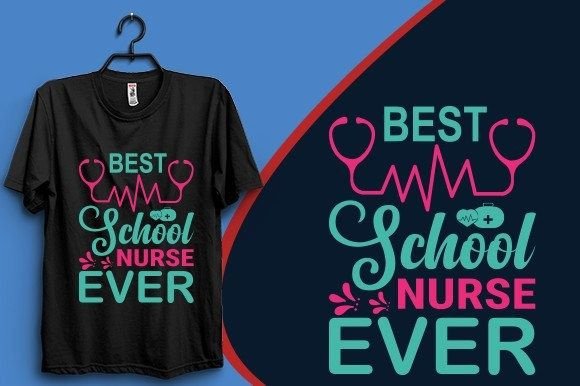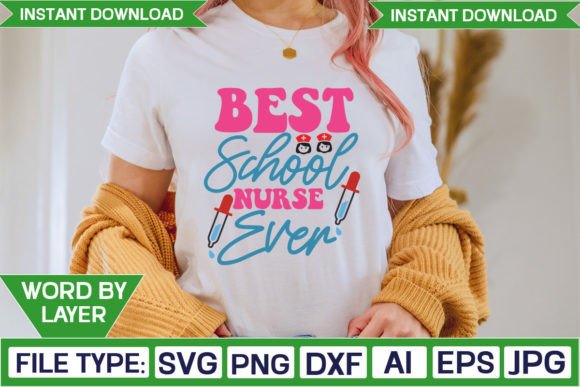
Reviewing the Best School Nurse Ever SVG for Embroidery
As a designer who spends half my life digitizing and the other half stitching, I have learned that not every cute graphic translates well to thread. We often see T-Shirt Designs and Graphics marketed as universal solutions, but embroidery demands a different level of scrutiny. When I first pulled up the Best School Nurse Ever Svg Design, my immediate reaction was one of cautious optimism. The typography is bold, which is promising for stitch clarity, but the real test is always in the hoop.
This review comes from the perspective of someone who has ruined plenty of good fabric with bad files. I am looking at this design not just as a digital asset, but as a physical product waiting to happen. Whether you are an Etsy seller preparing for back-to-school season or a hobbyist making a personalized gift for a friend in healthcare, understanding how this file behaves under the needle is crucial.
First Impressions and Visual Personality
The mood of this design is appreciative and professional without being overly clinical. It strikes a balance between warmth and authority, which is exactly what school nurses embody. Visually, the layout relies heavily on strong lettering. For embroidery, this is generally good news. Thick, clean lines allow for solid fill stitches or dense satin stitches that hold up well over time. However, the spacing between letters is critical. If the kerning is too tight, the threads will merge into a blob after washing. If it is too loose, the design loses its impact.
In my initial assessment, the design feels versatile. It does not scream "hospital" in a sterile way; instead, it feels like something that belongs on a cozy cardigan or a sturdy tote bag. This emotional resonance is vital for sales. Customers are not just buying a shirt; they are buying recognition for hard work. The design supports that narrative effectively.
Real-World Application: The Tote Bag Test
To truly evaluate the Best School Nurse Ever Svg Design, I imagined a specific project: a heavy-canvas tote bag for a nurse’s daily essentials. Canvas is unforgiving. It has a rough texture that can eat up fine details. I visualized placing this design on the front panel, centered and prominent.
For a tote bag design like this, the boldness of the text works in your favor. Thin, wispy fonts get lost in the weave of canvas, but the substantial weight of this design suggests it would sit nicely on the surface. I would recommend using a high-quality cut-away stabilizer to prevent puckering, especially if the bag will be loaded with books and supplies. The result would be a durable, professional-looking accessory that stands up to daily wear.
Another excellent application is sweatshirt embroidery. A fleece or cotton-blend crewneck provides a soft background that contrasts beautifully with shiny rayon or polyester threads. Here, the design becomes a badge of honor. It is subtle enough for daily wear but distinct enough to spark conversation in the breakroom. For custom apparel, this is a winner because it avoids the clutter of complex icons, focusing instead on clear, readable pride.
Navigating Fabric and Hoop Constraints
While the design is strong, it is not without its challenges. You must consider where it might fail. Small hoop sizes are the first enemy. If you are working with a 4x4 inch hoop, you may need to scale the design down significantly. At smaller sizes, the interior spaces of letters like "e" and "a" can close up due to thread pull. Always check the smallest element in the design before committing to a small hoop.
Textured fabrics also pose a risk. On a waffle-knit thermal or a highly textured towel, the edges of the letters might not look crisp. In these cases, a simple running stitch outline might help define the shape, but that depends on how the file is constructed. Since this is a vector-based source, you have some control, but if you are using a pre-digitized version, you are stuck with what you get.
Dark fabrics require careful thread color selection. White or light yellow thread on black fabric looks striking, but you must ensure the stitch density is high enough to cover the background completely. Gaps in coverage look amateurish. Conversely, on light fabrics, avoid threads that are too similar in value to the background, or the message will vanish from a distance.
Technical Considerations for the Maker
Let us talk about the files. The product description states you receive an AI file and an SVG file. As an embroidery professional, I must emphasize that SVGs are not native embroidery formats. You cannot plug an SVG directly into most home embroidery machines. You will need to use software to convert this vector graphic into a stitch file, such as PES, DST, or JEF, depending on your machine.
This conversion step is where many beginners stumble. If you are not digitizing yourself, you must hire a digitizer or use auto-digitizing software with caution. Auto-digitizing often creates excessive jump stitches and poor underlay, leading to a messy finished product. If you are selling this as a handmade product, the quality of the digitization matters more than the original graphic. Ensure you have the rights to create derivative stitch files if you plan to sell the embroidered items.
Check the license terms carefully. The description mentions "Digital Download Only," but it does not explicitly state commercial usage rights for the final stitched goods. Most designers allow you to sell physical items made with their designs, but you usually cannot resell the digital file itself. Clarify this before listing items on Etsy or at craft fairs.
Enhancing Value and Customer Trust
Why choose this design over a generic clipart? Consistency and professionalism. When a customer sees clean, well-spaced lettering on a personalized gift, they perceive higher value. It suggests care and attention to detail. For small business owners, this translates to fewer returns and better reviews. A sloppy embroidery job reflects poorly on your brand, while a crisp execution builds trust.
Consider using this design for holiday embroidery projects, such as Christmas ornaments or teacher appreciation gifts in May. The timeless nature of the text means it does not go out of style. It is not tied to a specific trend, making it a safe investment for your design library.
Final Verdict and Practical Tips
The Best School Nurse Ever Svg Design is a solid choice for makers who understand the limitations of their materials. It is not a magic bullet; it requires proper stabilization, appropriate thread choices, and correct scaling. However, its bold aesthetic makes it forgiving for intermediate embroiderers.
- Test on scrap fabric first: Never stitch directly on your final garment. Check for puckering and thread breaks.
- Contrast is key: Ensure your thread color stands out against the fabric texture.
- Verify file compatibility: Remember that SVG is a vector format, not a stitch file. Plan your conversion process.
- Consider the end use: Will this item be washed frequently? If so, use polyester thread for durability.
In conclusion, this design serves as a reliable foundation for a variety of embroidery project types. From baby embroidery on onesies to robust embroidered patch creations, it offers flexibility. Just remember that the digital file is only the beginning. The true art lies in how you bring it to life with needle and thread. Treat it with respect, prepare your materials well, and you will create a finished product that honors the profession it celebrates.